Ethical AI or Ethical Branding? The Labor Crisis Beneath the AI Boom
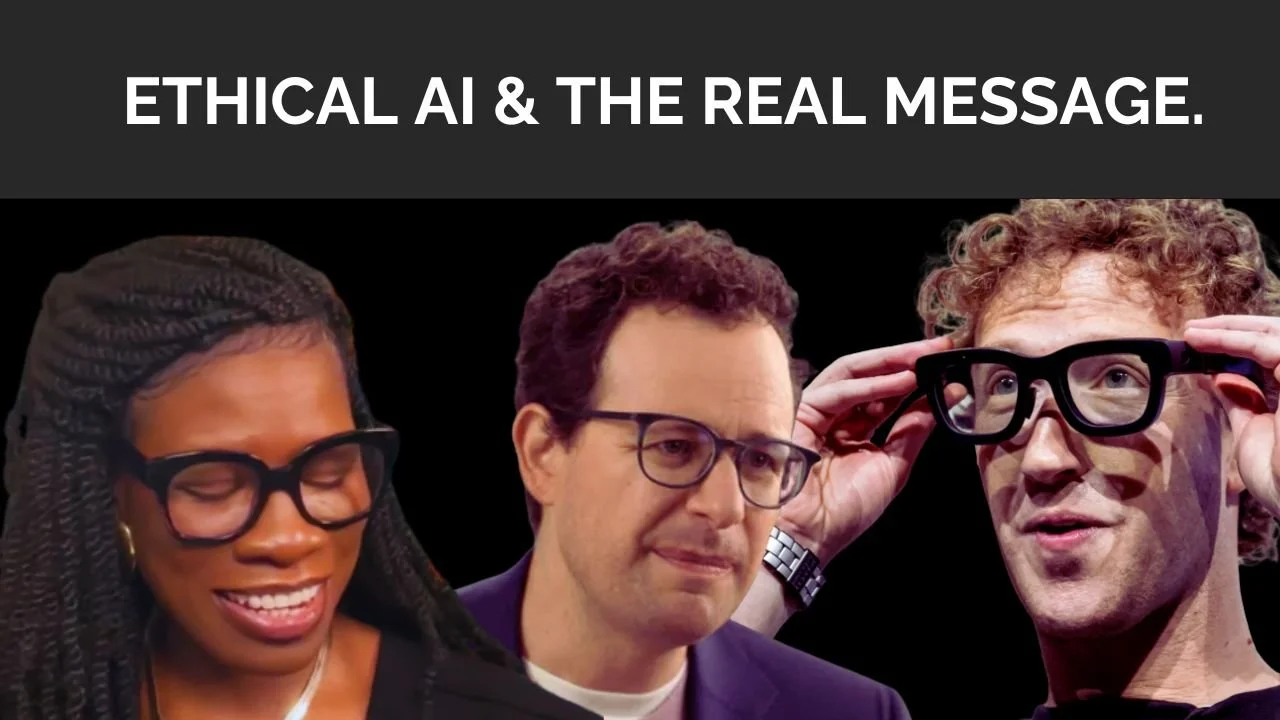
Over the last year, the public conversation around artificial intelligence has become increasingly polished. Every company suddenly has an “AI ethics framework.” Every executive panel includes language around trust, transparency, governance, and responsible innovation. But underneath all of that carefully managed language, two parallel realities are emerging.
One is about regulation.
The other is about labor.
And they are colliding in ways that many organizations still seem unwilling to fully acknowledge.
A recent TechTarget/Informa report examined how the federal government and the state of California are beginning to shape AI oversight not primarily through sweeping legislation, but through procurement power. In practical terms, that means governments are using contracts and purchasing requirements to quietly force companies to comply with certain standards if they want access to public dollars.
At the federal level, proposed guidance pushes for “neutral” AI systems that avoid ideological positioning, including around diversity, equity, and inclusion. California, meanwhile, is moving in almost the opposite direction, requiring companies to demonstrate protections against harmful bias and civil rights violations.
That creates a fascinating and uncomfortable tension.
Companies are now being asked to satisfy multiple competing definitions of fairness depending on who the buyer is. One regulator may define ethical AI as ideological neutrality. Another may define ethical AI as active anti-discrimination enforcement.
And because procurement dollars are attached to those definitions, businesses adapt accordingly.
The phrase that stood out most in the reporting came from OneTrust executive Ojas Rege: “Money drives behavior.”
Exactly.
This is why the current AI moment cannot simply be understood as a technological transition. It is also a political and economic restructuring exercise happening in real time.
At the same moment governments are debating how AI should behave, the labor market inside the technology industry is already being reshaped by AI acceleration itself.
Business Insider recently reported on Meta employees reacting to another major wave of layoffs expected to impact roughly 10% of the company’s workforce. Internally, workers described the atmosphere as “28 days of hell” while waiting to discover whether they would still have jobs. Employees discussed anxiety, uncertainty, exhaustion, and the growing expectation that surviving workers will simply absorb additional labor afterward.
One employee reportedly wrote that they felt “more anxious about surviving this layoff” because remaining workers would likely face heavier workloads in an increasingly fearful environment.
That statement reveals something many AI conversations still avoid.
The emotional reality of technological transition is not being distributed equally.
Executives discuss efficiency.
Investors discuss scale.
Governments discuss competitiveness.
Workers discuss survival.
Those are not the same conversation.
And that gap matters because AI ethics discussions often become strangely abstract. The focus tends to remain on bias testing, explainability, hallucinations, and compliance frameworks while avoiding deeper questions around power concentration, labor precarity, and economic displacement.
But labor is an ethical issue.
Workforce destabilization is an ethical issue.
The psychological toll of permanent uncertainty is an ethical issue.
If a company promotes responsible AI externally while simultaneously creating internal cultures of instability, overwork, and chronic insecurity, then the ethics conversation is incomplete.
What also concerns me is how flexible ethical language has become.
If one company can market “neutrality” to federal buyers while marketing “equity safeguards” to California regulators, then ethics risks becoming a branding layer rather than a coherent moral position.
And to be clear, this does not mean fairness testing, civil rights protections, or governance standards are unimportant. They absolutely matter. But ethics cannot simply be treated as a configurable feature set depending on who is paying.
Because once ethical standards become infinitely adjustable, trust begins to erode.
This is why the AI moment feels bigger than previous technology cycles.
Artificial intelligence is not just changing software. It is reshaping labor expectations, governance structures, economic incentives, organizational psychology, and even the emotional relationship workers have with stability itself.
Meanwhile, states across the country are increasingly attempting to regulate the consequences. Nebraska and Oklahoma are reportedly considering legislation tied to AI-driven pricing systems. Maine has temporarily paused large data center development over infrastructure concerns. Other states are debating rules around healthcare systems, chatbot protections for minors, and human review requirements for high-risk decisions.
In other words, the system already knows disruption is here.
The question now is whether governance will evolve quickly enough to protect people living through it.
Because underneath all the futuristic branding, there are real workers refreshing Slack channels, watching org charts disappear, updating résumés at midnight, and trying to understand where they fit into an economy increasingly organized around automation.
That is part of the AI story too.
And if we are going to have honest conversations about ethical AI, we need to start talking about the human conditions forming underneath the infrastructure, not just the infrastructure itself.